
Subjective Assignment
QUESTIONS BASED ON POTENTIAL, POTENTIAL DIFFERENCE & POTENTIAL ENERGY
Q1
Eight charges each of 4mC are kept at the corners of a cube of side 1m.Find the potential at
(a) center of cube (b) any corner of the cube.
Ans: 3332. 5´ 103 V
Q.2
Also find the work required to create the system of charges given in the previous question.
Q.3
A charge +2mC is kept at the origin and another charge of 1mC is to be carried from (2,2) to (6,2). Give the sign of
(a) Work done
(b) potential difference
(c) Change in potential energy.
Ans: All are –ve
Q.4
In the previous question if the source charge is negative then repeat the problem.
Ans: All are +ve
Q.5
Four charges 2mC each are kept at four corners of a square of side 1m.Find the work required to
(a) create this system
(b) take a charge of 2mC from center to the mid point of any side.
Q.6
Three charges each of 1mC are kept at the corners of a triangle of side 1m. Four charges each of 2mC are kept at the corners of a square of side 1m.Find the work required to take a charge of 3mC from the center of the triangle to the center of square.
Ans: 0.16J 7. 1012 m/sec2, 316.2 ´103 m/s
Q.7
Find the acceleration of an a particle which is kept between two plates having a potential difference of 2kV and separated by 10cm. Also calculate the velocity of a particle when started from rest and has travel a distance of 5cm.
Q.8
An electron gun produces an electron beam after accelerating them through a potential difference of 2kV. If the beam is allowed to enter in between two oppositely charged plates having a potential difference of 1kV and separated by 2cm. Find the upward or downward deflection in the beam by the time it travel between the two plates. Assuming that the beam is going parallel to the plates.
Ans: 6.25 L where L is the length of the plates
Q.9
An a particle is projected directly towards the nucleus of gold with a velocity of 104 m/s. Find the distance of closest approach.
Ans: 1.13 ´ 10-7 m
Q.10
The electric potential in a region is given by V = 2x2 +4x+5 volts. Find the electric field at a point (4,3).
Ans: . –20 V/m
Q.11
Three concentric spherical metallic shells A,B and C of radii a, b and c (c > b > a) have surface charge density s , -s and s respectively. Find the potential of three shells at the surface of A, B and C. If A and B are at the same potential then find the relation between a, b and c.
Q.12
A solid sphere is uniformly charged with charge density of 20mC/m3. If the radius of the sphere is 10cm.Find the potential at the center of this sphere.
Ans: 7.5 MV
Q.13
A uniformly charged solid sphere has a total charge of 10mC and radius of 15cm. Find the work required to take a charge of 2mC from the surface to its center.
Ans: 0.06J
Q.14
Show graphically the variation of potential and electric field w.r.t. distance from the center of
(a) uniformly charged hollow sphere & cylinder
(b) uniformly charged solid sphere & cylinder.
Q.15
Two uniformly charged ring have radius of 30cm each and charges of 20mC and -5mC. They are kept coaxial at a distance of 40cm from each other. find the work required to carry a charge of 2mC from the center of one ring to center of other.
Ans: 0.06J
Q.16
Two hollow concentric spheres of radius 10cm and 20cm are given a total charge of 20mC such that their surface charge densities are same. Find the potential at their common center.
Ans: 108´1014 V
Q.17
Two spheres have radius of 20cm and 5cm. Initially they have charge of 10mC and -6mC. When they are touched through a wire find the final charge on each of them.
Q.18
Potential at the center of a uniformly charged solid sphere is x times the potential at its surface Find x . Also Draw a graph between potential and distance for it.
Ans: X=3/2
Q.19
The potential variation w.r.t. distance in a region is shown. Find the electric field at r = 5m
Ans: –2.5V/m
Q.20
Describe schematically the equipotential surfaces corresponding to
(a) a constant electric field in the z direction,
(b) a field that uniformly increases in magnitude hut remains in a constant (say z) direction,
(c) a single positive charge at the origin
(d) a dipole
(e) a pair of positive and negative charge
Q.21
In a hydrogen atom, the electron and proton are bound at a distance of about 0.53 A:
- Estimate the potential energy of the system in eV, taking the zero of the potential energy at infinite separation of the electron from proton.
- What is the minimum work required to free the electron, given that its kinetic energy in the orbit is half the magnitude of potential energy obtained in (a)?
- What are the answers to (a) and (b) above if the zero of potential energy is taken at 1.06 A separation?
Q.22
Two charged conducting spheres of radii a and b arc connected to each other by a wire. What is the ratio of the electric field at the surfaces of the two sphere?
- , 205.1 ´ 103 V
- All are –ve 4. All are +ve
- 0.16J 7. 1012 m/sec2, 316.2 ´103 m/s
- 25 L where L is the length of the plates.
- 13 ´ 10-7 m
- –20 V/m
- 7.5 MV 13. 0.06J
- 0.06J 16. 108´1014 V
- X=3/2 19. –2.5V/m
Subjective Assignment
QUESTIONS BASED ON CAPACITOR
Q.1
A parallel plate capacitor has two plates of sides 0.055 m and 0.04 m of air. Their distance apart is 0.7 mm. The dielectric constant of the medium in between is 4. Find the capacitance of the capacitor.
Ans: 1.1´10-10 F
Q.2
A parallel plate capacitor has plates of area 0.02 m2 and separation between the plates 1 mm. What potential difference will be developed, it a charge of 1 nC is given to the capacitor? If the plate separation is now increased to 2 mm, what will be the new pot. difference?
Ans: 5.65 V ; 11.3 V
Q.3
Three capacitors of 3 mF each are connected in series. This combination is connected in series to another combination of three capacitors of 1 mF each in parallel. Find the total capacitance.
Ans: 0.75 mF
Q.4
The capacities of three capacitors are in the ratio of 1:2:3. Their equivalent capacity in parallel is greater than their equivalent capacity in series by 60/11 pF. Calculate their individual capacitances.
Ans: 1 pF, 2 pF, 3 pF
Q.5
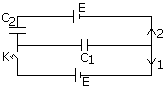
Calculate the charges which will flow in sections 1 and 2 in Fig. when key K is pressed
Ans:EC1;
Add Your Heading Text Here
Q.6
Two parallel plate capacitors of capacitance C and 2C are connected in parallel and charged to a potential difference of V volts .The battery is then disconnected and the region between the plates of capacitor C is completely filled with a dielectric of constant K. Find the new potential difference across the capacitors.
Q.7
Two capacitors C1 and C2 are connected in parallel and a charge q is given to the circuit. Find the ratio of the charges shared by them.
Q.8
A capacitor of 4mf is charged to a potential of 200V.And then it is connected to a uncharged capacitor of 2mf in parallel. Find the final common potential difference on the capacitors also find the energy loss during the process.
Q.9
In the previous question if the plates of the two capacitors are connected in opposite sense what would be the answer?
Q.10
A capacitor of 10mf is charged to a potential difference of 100V.It is then connected to another uncharged capacitor in parallel. If the final common potential difference is 40V then find the capacitance of the second capacitor.
Q.11
A parallel plate capacitor is maintained at a certain potential difference. When a dielectric of thickness 3mm is introduced between the plates , in order to maintain the same potential difference the distance between the plates has to be increased by 2.4 cm. Find the dielectric constant of the slab.
Q.12
Twenty seven drops of oil having equal charge q are combined to form a bigger drop. Find the final
(a) capacitance (b) potential (c) charge of the new drop.
Q.13
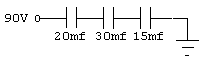
Three capacitors of 20,30 & 15 mf are connected in series as shown. Find the potential difference on the middle capacitor.
Add Your Heading Text Here
Q.14
Three capacitors are connected in series to a battery of 150V.The voltage across the two capacitors are 40 and 50 volts and the charge over the first capacitor is 0.16mC. Find the capacity of the capacitors .
Q.15
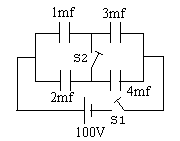
Find the charge over each capacitor when
- the switch S1 is closed
- the switch S2 is also closed
Add Your Heading Text Here
Q.16
Two capacitors A and B are connected in series with a 100v battery and it is observed that p.d. across them are 40V and 60V respectively. A capacitor of capacitance 6mf is now connected in parallel with B and as a result the p.d. across B falls to 50V.Find the capacitance of A and B.
Q.17
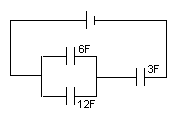
In the circuit shown below the energy stored in 6F capacitor is E. Find the energy stored in the 12F and 3F capacitors. Also find the total energy drawn from the battery
Add Your Heading Text Here
Q. 18
A large number of 2mf capacitors are available with a voltage rating of 250V and a battery of 1200V is provided. Find a possible way to get a capacitance of 4mf with these capacitors.
Q.19
A sphere of radius 1m is placed in air of dielectric constant 3×10⁶V/m. How much it can store. Find its potential before its discharging starts.
Q.20
Find the net capacitance of the following circuits across A&B assuming all capacitors of capacitance `C’.
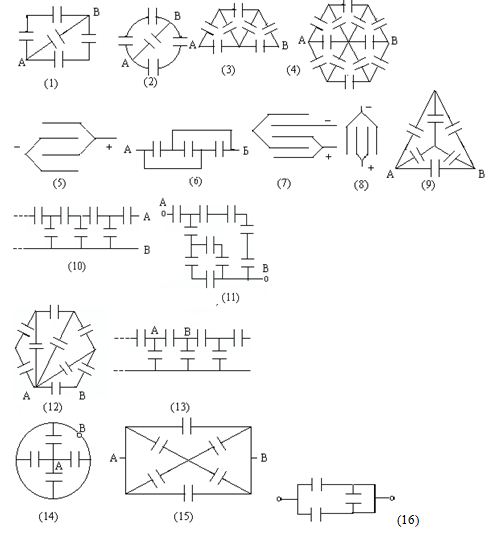
Q.21
Find the capacitance of the following capacitors which are filled with dielectrics as shown in the figures.
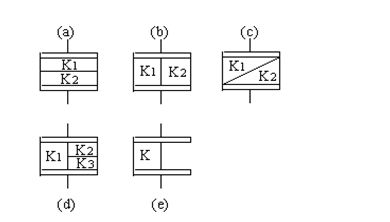
Q.22
A parallel plate capacitor of plate area 10-2 m2. And plate separation of 1cm is charged to 100 volt. Then the battery is removed and a dielectric slab of constant 7 and thickness 0.5cm is inserted between the plates. Calculate the free charges on the plates , electric field intensity between the plates before and after inserting the slab, potential difference between the plates and the capacitance with slab.
Q.23
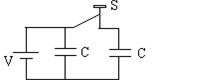
The figure shows two identical parallel plate capacitors connected to a battery with switch `S’ closed. The switch is now opened and the free space between the plates of the capacitors is filled with a dielectric of constant 3. Find the ratio of the total energy stored in both the capacitors before and after the introduction of the dielectric.
Q.26
Show that the force on each plate of a parallel plate capacitor has a magnitude equal to 1/2 QE, where Q is the charge on the capacitor, and E is the magnitude of electric field between the plates. Explain the origin of the factor 1/2.